Stepped XML Reader
A webservice rarely returns a whole dataset in one response. More often the first request returns a list, of order ids or of URLs, and you have to fetch the detail behind each one separately.
Stepping makes the XML Reader do that for you. It issues a request per record and assembles the responses into a single dataset, with the parent-child structure intact.
Stepping needs the http(s) Url controller
Stepping needs the http(s) Url controller. This page is about reading from a webservice. A reader on the File, Email or Transaction controller has no Url For Steppable Reader field.
Everything else about the reader — namespaces, the entry point, transaction XPaths, the field grid — works as it does on the XML Reader page. This page covers only what stepping adds.
Url For Steppable Reader
This field turns stepping on. It appears on the Field Mapping tab, on every transaction, once the controller is http(s) Url.
![The XML Reader Field Mapping tab with the root transaction selected, showing XML Entry Point set to /orders/order/order_id and Url For Steppable Reader set to /admin/order-%[SYS.ITEM]](../../../assets/Documentation/Resources/Images/UG/7.Readers/stepped-01.png)
A transaction steps only when its own Url For Steppable Reader has a value. If it is empty, the reader reads that transaction from the response its parent already fetched, as it would without stepping. A reader can therefore step at the top and not below it, or step only at one child. The two modes below are the two places a value can go.
The token spelling a URL needs
You parameterise the URL with the values of fields, written %[FieldName].
A bare token ends at a space, so a URL needs the bracketed form
Use the bracketed form in a URL. You can write a token either as
%[FieldName] or bare as %FieldName, but a bare token ends at the next
space, and only at a space. URLs do not contain spaces, so
takes the field name to be SYS.ITEM/lines, finds no such field, and fails
or substitutes nothing. /admin/order-%[SYS.ITEM]/lines works as intended.
IMan reports an unclosed bracket as a parse error naming its position.
Seed list
The first request returns a list of values, and the reader makes a request of its own from each value.
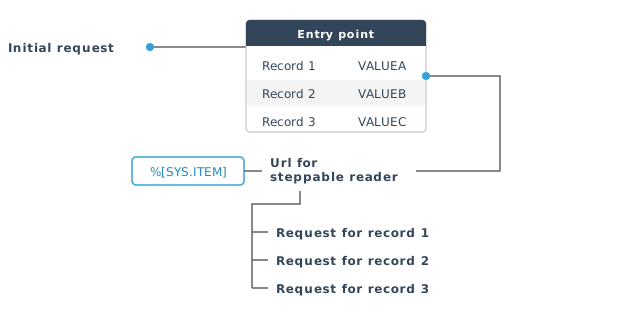
- The initial request is the one the controller's Query Url describes. The reader makes it once.
- The XML Entry Point picks the value out of that response. Without
stepping it would pick out the records. Here it picks out the single value
that identifies each record. An entry point of
/orders/order/order_idyields one order id per order. - Each value is substituted into the top transaction's Url For Steppable
Reader through
%[SYS.ITEM], and the reader makes a request for each. The value can be the whole URL or, as here, a fragment of one. - Each response is read as one top-level record. The transaction's own XPath is the entry point into that response, and the XPaths of its fields and child transactions are relative to it.
Example
Query Url:
which returns a summary list:
XML Entry Point: /orders/order/order_id
Url For Steppable Reader, on the top transaction:
The reader then requests /admin/order-101 and /admin/order-103 in turn,
and each returns a whole order:
<order>
  <order_id>101</order_id>
  <customer>ABC001</customer>
  <line_items>
    <line_item>
      <item_id>A1-103/0</item_id>
      <qty>5</qty>
    </line_item>
  </line_items>
</order>
The top transaction's XPath is /order. Relative to it, order_id reads
the order id, and a child transaction over the line items has a Transaction
XPath of line_items/line_item.
Parent to child
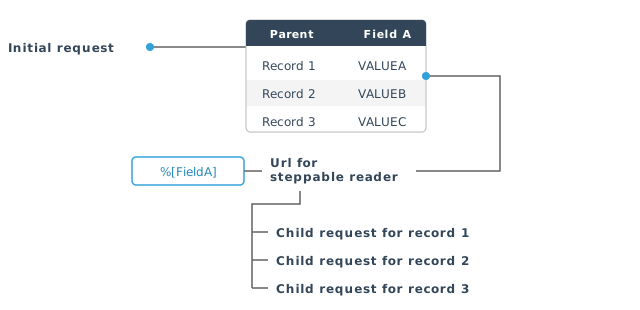
This mode applies the same idea one level down. Any field of a parent record can build the request that fetches its children.
![The XML Reader Field Mapping tab with a child transaction named Payment selected, showing its Url For Steppable Reader set to /admin/order-%[order_id]/payments](../../../assets/Documentation/Resources/Images/UG/7.Readers/stepped-02.png)
The seed list can offer only one value, through SYS.ITEM. Parent-to-child
can use any field of the parent, referred to by its own name, so you can
build a request from an id, a date and a currency together.
For each record in the parent, the reader makes a request from the child's Url For Steppable Reader and inserts the response as that record's children. The child's Transaction XPath is the entry point into its own response, exactly as the top transaction's is into the seed response.
The example above fetches an order's payments from a second endpoint:
/admin/order-%[order_id]/payments produces /admin/order-101/payments for
order 101.
Using both
You can use both modes in one reader. A reader can seed its top level from a summary list and then step again from each order to its payments, because each transaction's own Url For Steppable Reader decides whether it steps.
When a stepped reader returns less than you expected, check this first. A transaction whose Url For Steppable Reader is empty is not broken. It reads from the response above it.