Loops
A loop runs the same statements more than once. VBScript offers several, and they differ in what they test and when they test it.
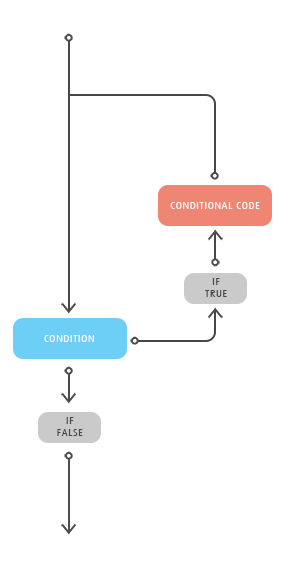
This is not the dataset's own iteration
IMan already runs a field expression once per record. This page is about looping within a single evaluation, over an array or a collection you built yourself. The dataset's own iteration is the Data Processing Pattern.
Most expressions need no loop at all.
Choosing a loop
| Loop | Runs | Tests |
|---|---|---|
For |
A counted number of times | Before each pass |
For Each |
Once per element of an array | Before each pass |
While |
While the condition is True | Before each pass |
Do While |
While the condition is True | Before or after, your choice |
Do Until |
Until the condition becomes True | Before or after, your choice |
A loop that tests after the pass always runs at least once.
Exit For and Exit Do leave a loop early.
For
For counts from one number to another. Step sets the size of the increment, and
defaults to 1.
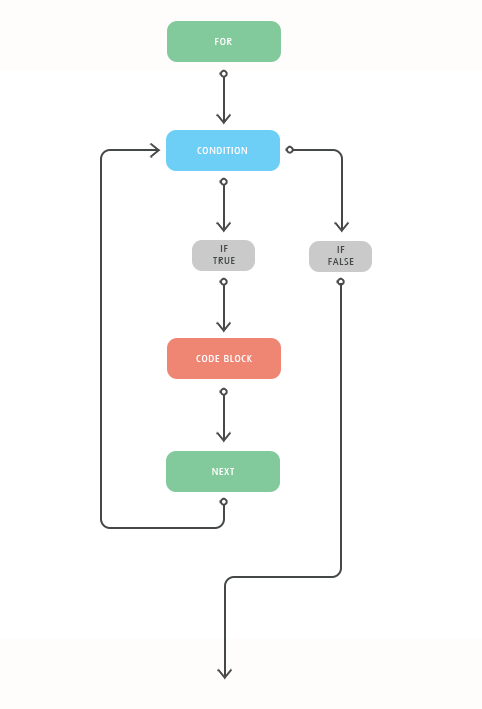
The counter takes the start value, and the loop runs while the counter has not passed
the end value. Next adds the increment, and the loop tests the counter again.
Totalling a counted range
The expression returns 15.
Counting in twos
i takes 0, 2, 4, 6, 8 and 10, and the expression returns 30.
A negative Step counts down. For i = 10 To 1 Step -1 runs ten times.
For Each
For Each runs once for every element of an array, without a counter.
This is the loop you will use most often, because
Split turns a delimited
field into an array and For Each walks it.
Prefixing every code in a delimited field
Dim Codes
Dim Code
Dim List

Codes = Split(%WarehouseList, ",")
List = ""

For Each Code In Codes
  If List <> "" Then List = List & ","
  List = List & "WH-" & Code
Next

List
With %WarehouseList holding MAIN,NORTH,RETURNS, the expression returns
WH-MAIN,WH-NORTH,WH-RETURNS. The If puts a comma before every code except the
first. An empty field gives Split no elements, and the expression returns an
empty string.
For Each needs an array
For Each over a string or a number raises error 451, "Object not a
collection", rather than running no passes. Where the value may not be an array,
test it with IsArray first.
While
While tests its condition before each pass and runs until the condition is False.
Wend ends the loop.
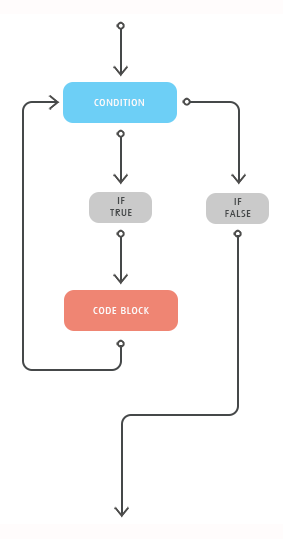
A condition that is False on entry means the statements never run at all.
Totalling until a limit
Dim Counter
Dim Total

Counter = 10
Total = 0

While Counter < 15
  Counter = Counter + 1
  Total = Total + Counter
Wend

Total
Counter takes 11, 12, 13, 14 and 15, and the expression returns 65.
Do While
Do While runs while its condition is True. The condition goes at the top or at the
bottom, and the position changes the behaviour.
Testing first
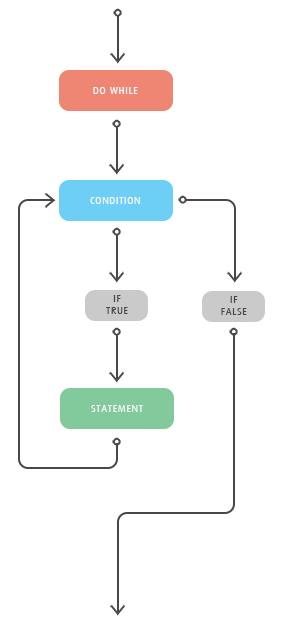
The condition is True on entry
The expression returns 15.
Testing last
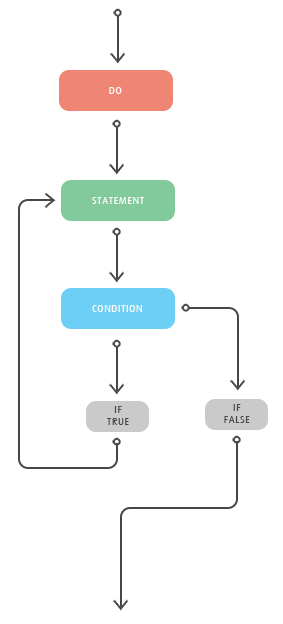
The statements always run once, whatever the condition says, because nothing has tested it yet.
The condition is False on entry
i is already 10 and the condition fails at the first test. The pass has already
run by then, and the expression returns 11.
Do Until
Do Until inverts the sense of Do While. It runs until its condition becomes True.
Testing first
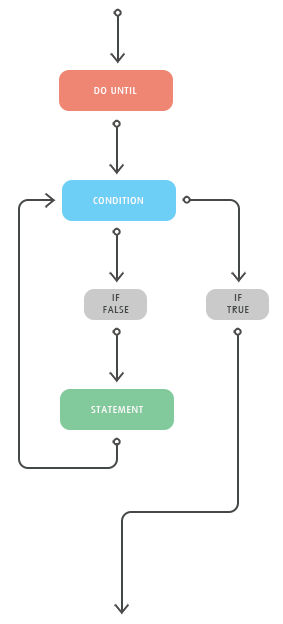
Running until the counter passes a limit
The loop tests the condition before each pass, and each pass increments i before
the next test sees it. i takes 11 through 16 and the expression returns 81.
Testing last
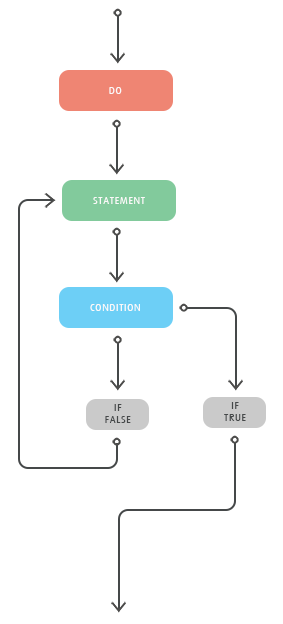
The statements always run once here too.
The condition is already True
The pass runs, i becomes 11, and 11 < 15 ends the loop. The expression returns
11.
Leaving a loop early
Exit For and Exit Do stop a loop and carry on at the statement after it. Neither
runs the rest of the current pass.
Exit For
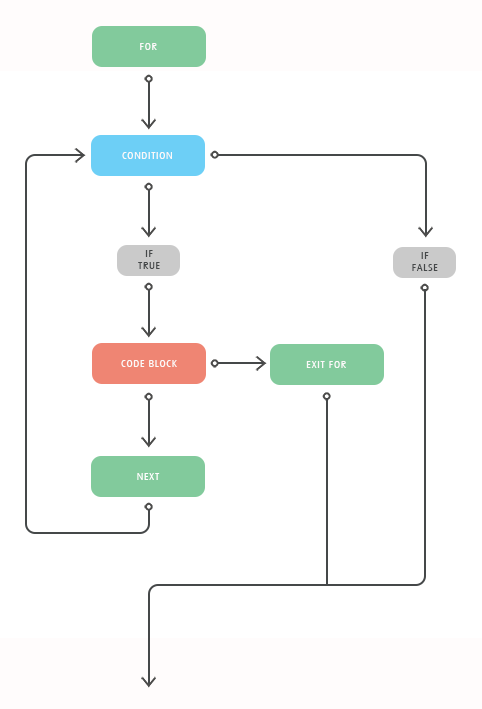
Stopping the count at four
Dim i
Dim Total

Total = 0

For i = 0 To 10 Step 2
  Total = Total + i
  If i = 4 Then
    Exit For
  End If
Next

Total
i takes 0, 2 and 4, and the expression returns 6.
Exit Do
Exit Do works in a Do While and in a Do Until alike.
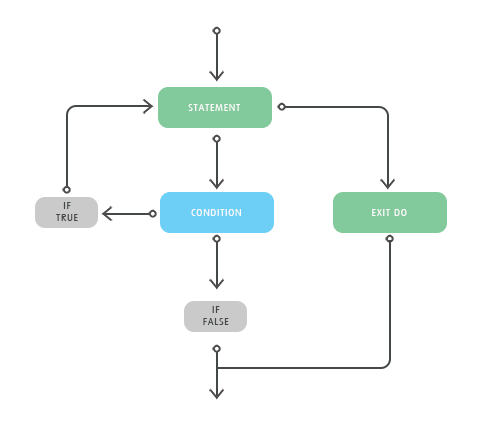
Stopping before the condition would
Dim i
Dim Total

i = 0
Total = 0

Do While i < 100
  i = i + 1
  Total = Total + i
  If i = 5 Then
    Exit Do
  End If
Loop

Total
The condition would allow a hundred passes. Exit Do ends it after five, and the
expression returns 15.
A loop that never ends fails the record after a minute
IMan stops an expression that runs for more than 60 seconds, and reports "The
script was aborted because execution exceeded the specified timeout period". A
While or a Do whose condition never becomes False reaches that limit. The run then
treats it as any other
runtime error.
Change something inside the loop that the condition tests, and prefer For
wherever the number of passes is known before the loop starts.