Asynchronous Jobs
An endpoint whose Response Mode is Asynchronous queues each request it receives as an asynchronous job, and the Realisable Scheduler Service runs the queued jobs in the background. Setup > Asynchronous Jobs, in the WEB API group, holds the limits that apply to all of them. Asynchronous Requests describes what the caller sees.
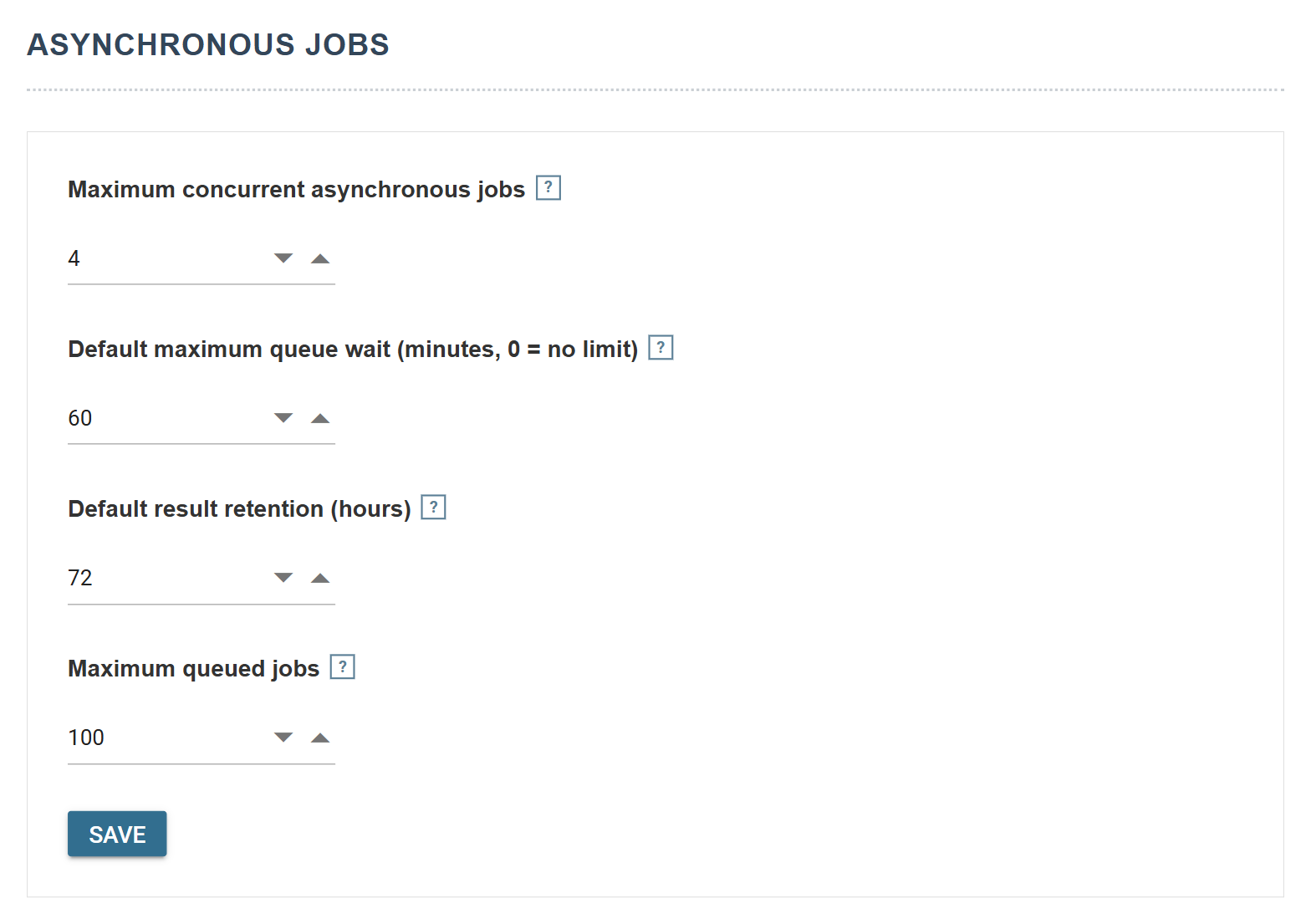
Only an administrator can open the page. Press Save to apply a change. The Scheduler reads the settings each time it checks the queue, at least once a minute. A change takes effect without a restart.
Maximum concurrent asynchronous jobs
How many asynchronous jobs run at the same time, across all asynchronous endpoints. It starts at 4, and the minimum is 1. A job beyond the limit waits in the queue until a running job finishes.
Each running job is an engine process with its own logins to the systems the integration connects to. Set the limit to what the server and those systems can carry. Scheduled runs neither count towards the limit nor wait for it.
A job also waits while its integration is already running as many instances as it allows, whatever this limit says.
Default maximum queue wait (minutes, 0 = no limit)
How long a job may wait in the queue before it fails. It starts at 60, and 0 means no limit. The wait counts from when the WebAPI accepted the request. A job that has not started in time fails with 504 and the message The request did not start within 60 minutes.
An endpoint can set its own wait with Override queue wait on the endpoint.
Default result retention (hours)
How long IMan keeps a finished job's status and result for the caller, counted from when the job finished. It starts at 72, and the minimum is 1. After that, IMan removes the job and its result, and the caller receives 404 for both.
IMan keeps results in its own database. A long retention on an endpoint that returns large results makes the database grow. A change applies to jobs that finish after it. A job that has already finished keeps the expiry time it was given.
An endpoint can set its own retention with Override result retention.
Maximum queued jobs
How many jobs may wait in the queue at once, across all asynchronous
endpoints. It starts at 100, and the minimum is 1. Running jobs do not count.
While the queue is full, the WebAPI refuses new asynchronous requests with
429 Too Many Requests and a Retry-After: 30 header.
The limit bounds how much the queue can hold. Each queued job keeps its request body in the IMan database until it runs.